"Akahai", meaning kindness,
to be expressed with tenderness;
"Lokahi", meaning unity,
to be expressed with harmony;
"Oluolu", meaning agreeable,
to be expressed with pleasantness;
"Haahaa", meaning humility,
to be expressed with modesty;
"Ahonui", meaning patience,
to be expressed with perseverance
The salt marsh harvest mouse lives endemically in the green highlighted areas. Meaning is only found in the salt water marshes surrounding the 4 bays (South Bay, San Francisco Bay, Suisun Bay, and San Pablo Bay) that connect to make the San Francisco Bay Area. This brings me to why the mouse is endangered. Over 85% of the bay area's marsh lands have been developed into homes, businesses, and salt ponds since 1850. The area most impacted are the higher marsh lands that the mouse used to retreat to in high tide, but also, because of development, a lot of the tidal salt marshes have been protected by levees and sloughs to prevent businesses and homes from being effected by tides, so the marsh lands no longer flood twice a day do to the tides. Also Cargill (the company that owns the salt ponds) has created land
that is no longer tidal but only lets salt water into ponds so that they can dry the ponds up to harvest the salt, eventually that salt is what we use at our kitchen tables. The downside to the environment is it makes the soil super saline and takes away any ability for even salt tolerant plants and animals to survive (to the left is a picture of a mountain of salt being harvested). The final biggest impact that has happened with the area is the bay areas water treatment facilities are dumping its treated water into some of the sloughs creating fresh water streams to the bay in water that used to be brackish (moderately salty) which brings in a whole host of species that can now survive in that environment creating a whole host of invasive species to the area.
Characteristics of the Salt Marsh Harvest Mouse:
this mouse is unique in that it survives a high ingestion of salt as its normal systems. Its cute small and is a food source for another endangered species, specifically the clapper rail (shown to the right).
What can be done to help?
Don Edwards San Francisco Bay National Wildlife Refuge is always looking for volenteers to help maintain and restore the land, as well as helping with the many vistors and field trips comming by. The Don Edwards Refuge is located at the very southern most point of the South Bay, so is nestled in an urban area, so lots of urban problems to keep up with, like grafitti, and litter, as well as weeding out the non-native species.
For teachers, they have programs for any grade level to come out and explore the marsh lands and learn about all of the species, and learning the importance of the water your using, and how to use it wisely. Besides its beautiful. Just don't forget the sunblock.
As far back as the fifth century B.C. a bitter powder made from willow tree bark has been used to ease aches and pains. The first person to write about this was Hippocrates. In the 1700's Reverend Edmond Stone noticed the abilities of willow to cure fevers with aches, and he wrote about it. Early scientists only knew that the willow bark was bitter and good for fever and pain because of a chemical called salicin (discovered in 1829). (picture of the willow to the left)
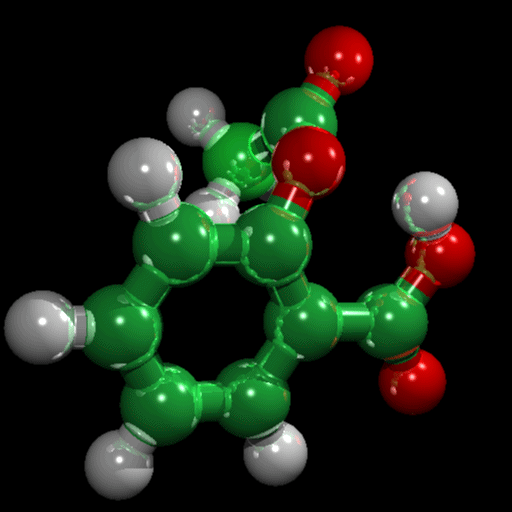
Salicin is an acid that is very rough on the stomach lining causes a great deal of problems. As a result a chemist Felix Hoffmann who worked for the company Fredrich Bayer & Co. tested compounds to fix the problem. The result was acetylsalicylic acid (ASA or aspirin) it was gentler than salicin to the stomach and more effective against pain, swelling and fever. It was then named after a rose that actually produces the compound naturally (picture to the left).
I am curious about VOG what is it? why is it dangerous? how does it form? how much is produced?
VOG is an abbreviation for volcanic smog, a specific form of natural air pollution. It is composed
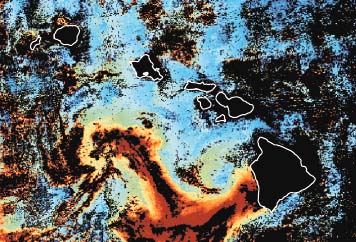
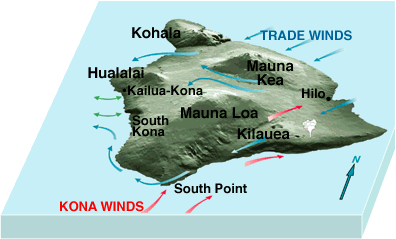
of Sulfur dioxide (SO2), Hydrogen Sulfide (H2S), and Carbon Dioxide (CO2) gasses when it is initially released from the volcano. When magma is exposed, it releases the previously mentioned dissolved gasses into the atmosphere. At which point the gasses mix with moisture and oxygen in the air aided by sunlight to create other gasses and aerosols, one example is Sulfuric Acid (H2SO4). Kilauea Releases anywhere from 1,000 to 2,500 TONS of SO2 per day. That gas then travels down to the south coast then right back north along the Kona side of the island, and then it blows off over the ocean (the picture on the left shows the VOG as red and yellow and the picture to the lower right shows the trade winds that move the VOG around the island). Although most people don't really get
bothered by these gasses, for some it can cause problems because the aerosols tend to stay in your lungs. Results of exposure to VOG can be headaches, Breathing difficulties (including asthma), flu-like symptoms, and in severe cases problems with skin being irritated and itchy.
Sources
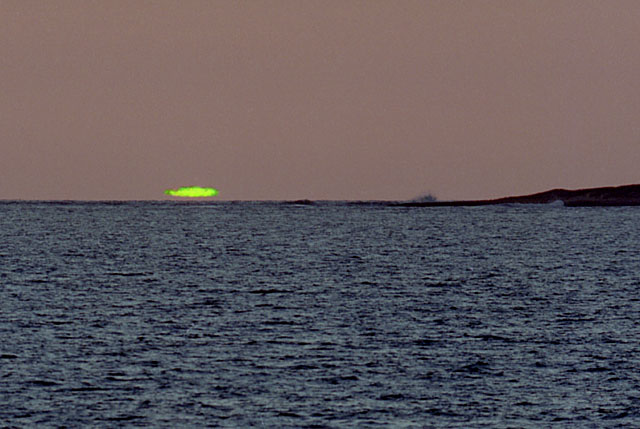
USGSA green Flash occurs during a sunset (or sunrise), and i knew that they occurred off of the cost on the Kona side of the island. So i was wondering what causes them? and how can I find the right conditions to see one?
Seeing the Flash has a few rules

this, especially since i thought that spiders were extremely territorial, and are they poisonous?